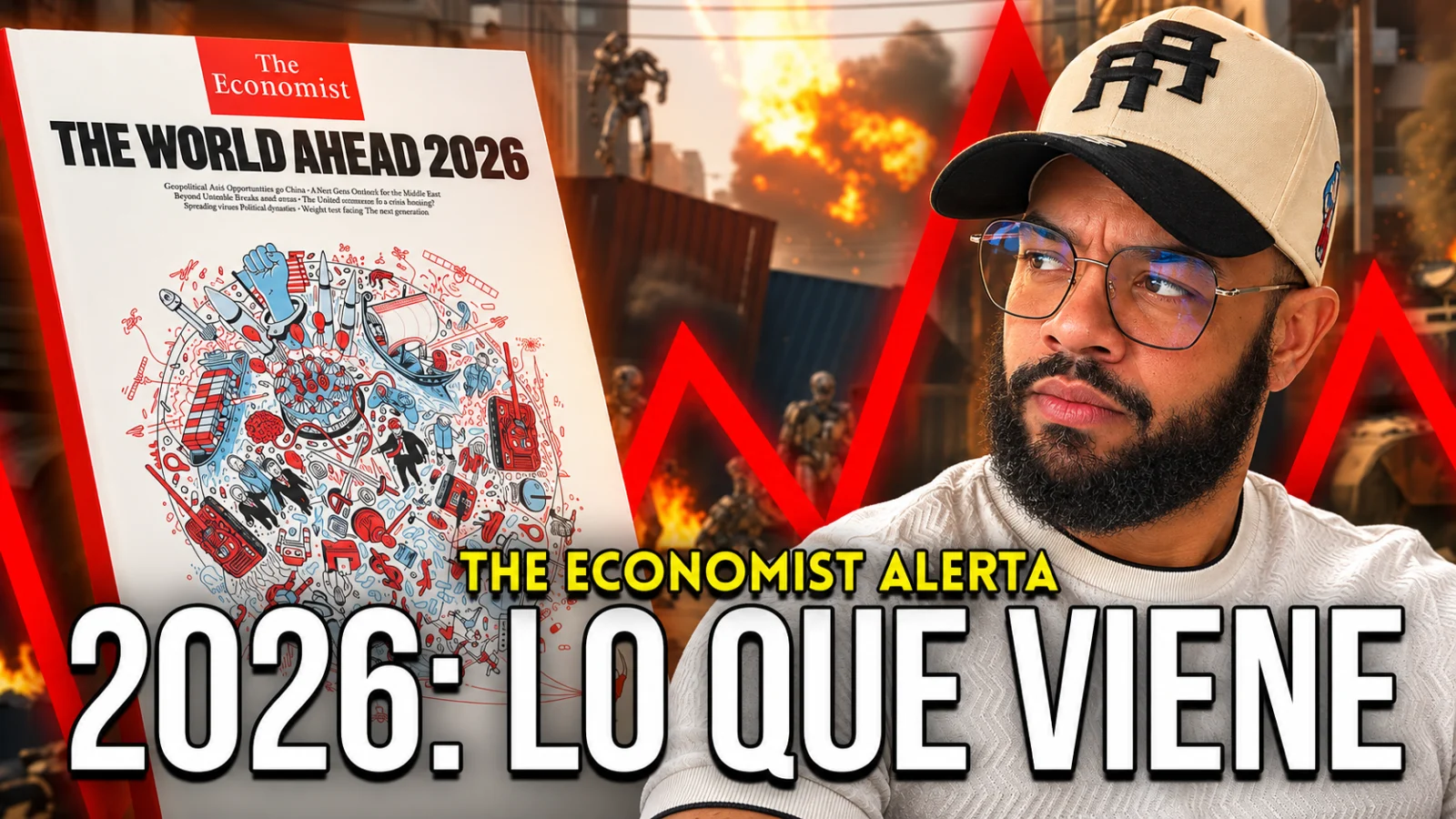
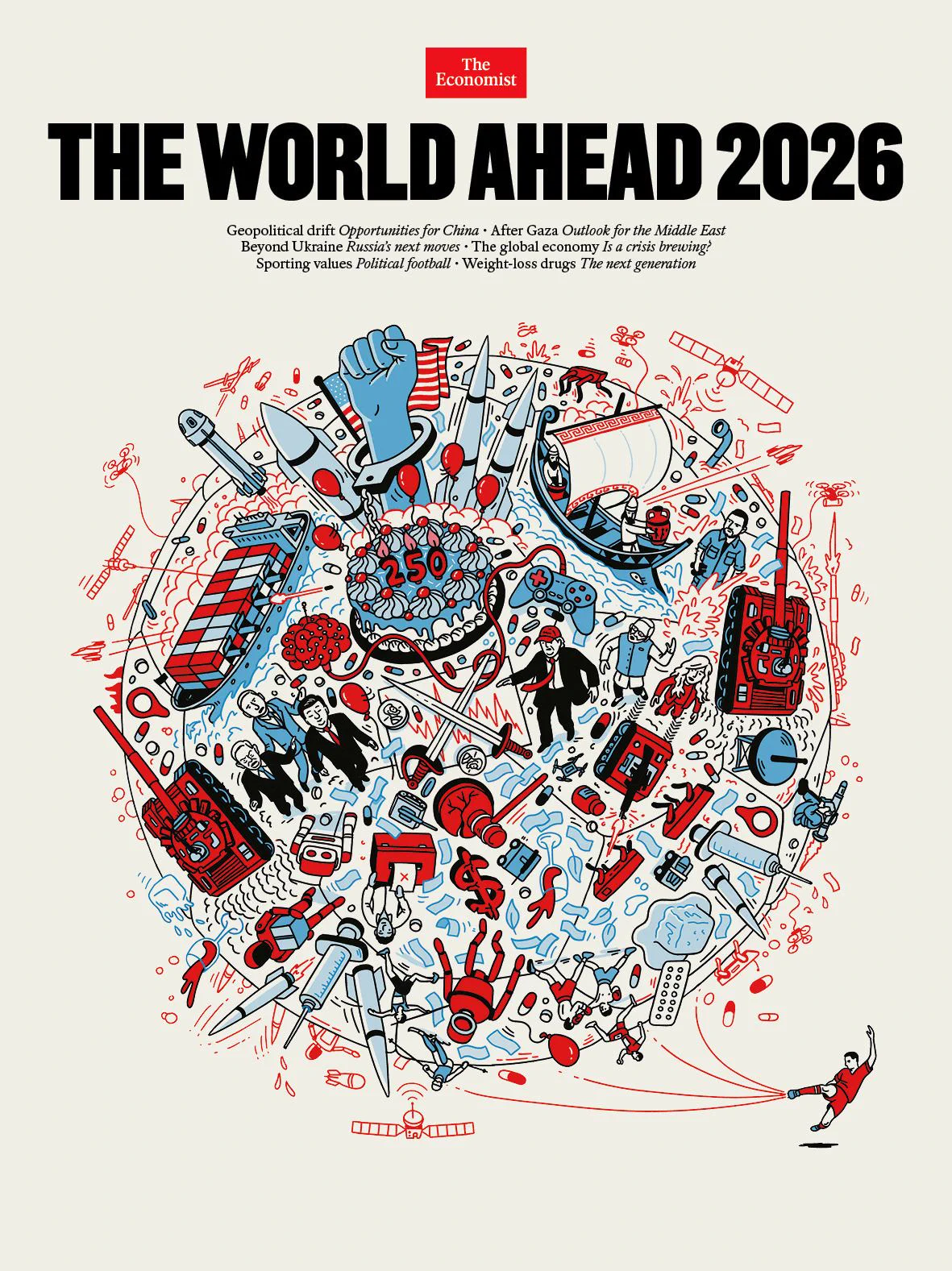
A cake marked “250,” military equipment and medical imagery make The Economist’s The World Ahead 2026 cover an attention-grabbing illustration. Understanding it requires reading the articles behind the artwork, rather than treating each object as evidence of a hidden prediction.
This explainer examines what the publication announced, what was already public knowledge and where interpretation goes beyond the evidence. It does not claim that all the issue’s forecasts came true.
An annual forecast published before 2026
The publisher’s November 10, 2025 announcement introduced the 40th edition of its forecasting annual, edited by Tom Standage. It was also included in the weekly print issue dated November 15, 2025. This is an outlook prepared last year, rather than a new forecast for the remainder of 2026.
La Fiebre 101.7 FM
 La Fiebre 101.7 FMLa música y la voz de Cleveland.ESCUCHA EN VIVO
The subjects behind the artwork
The publisher’s launch explanation is the starting point. Its themes connect geopolitics, economics, technology, health and culture. We distinguish that documented agenda from our interpretation of the drawing.
The cover, symbol by symbol: a detailed reading guide
How to read this guide: “Documented context” means a subject or event supported by a named source. “Interpretation” means our reading of the drawing. “Unconfirmed” means we found no authoritative explanation identifying that particular detail. A documented topic does not automatically confirm every artistic choice.
Use the full-size cover above as your reference. The crowded illustration has overlapping objects, so some tiny shapes remain ambiguous. The guide covers the major recognizable elements and groups repeated items together.
1. The cake marked “250”: America’s anniversary
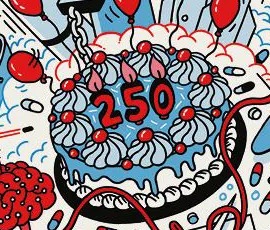
Documented context. This is the clearest reference: July 4, 2026 marked 250 years since American independence, as documented by the National Archives. A birthday cake turns an abstract anniversary into an immediately recognizable image. Its placement among weapons, politicians and medicine creates a visual contrast between celebration and anxiety. The anniversary was known long before the cover was drawn; its presence is not an example of predicting an unexpected event.
2. The raised blue fist and handcuff: resistance under constraint
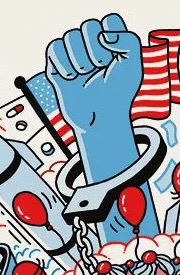
Interpretation. A raised fist commonly communicates defiance, solidarity or a struggle over power. The cuff adds the idea of restraint, detention or limited freedom. Together, they invite questions about who holds power and who can challenge it. We cannot confirm that the artist intended one named protest movement, one party or a particular arrest. Blue ink alone does not establish that the fist represents Democrats.
3. The American flag beside the fist: a contested national identity
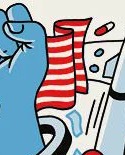
Interpretation. The flag identifies the American setting of the anniversary imagery. Placing it beside a restrained fist makes it reasonable to read this cluster as tension over freedom, authority and national identity. Readers can disagree about that artistic reading. The drawing supplies no specific date, law or individual whose rights will be restricted.
4. The large circular world: everything is connected
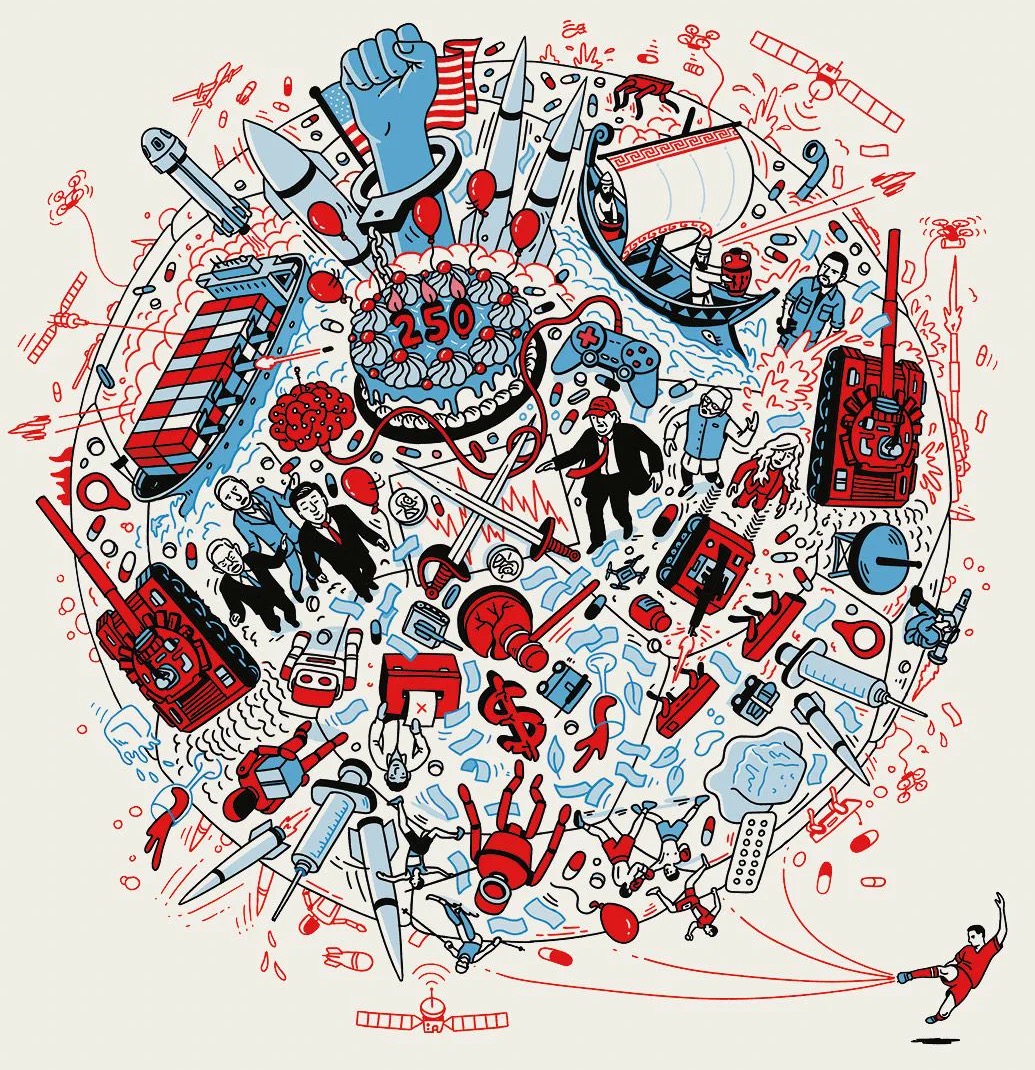
Interpretation. The objects form a ball-like world, with political, military, medical and technological scenes crowded together. Our reading is that developments in one field spill into another: conflict can affect trade, technology can affect work, and politics can affect finance. The circle also connects visually with the footballer. It is not a reliable geographical map or a calendar unless the publisher supplies a key establishing those functions.
5. The footballer outside the circle: sport meets geopolitics
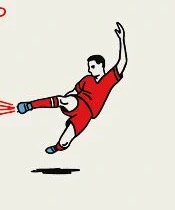
Documented context plus interpretation. The 2026 World Cup was awarded to the United States, Canada and Mexico in June 2018. A player kicking a world-sized ball can therefore connect the tournament with international politics. The character’s jersey does not establish a winning national team, and the drawing is not evidence that match results were arranged.
6. The red curved lines: motion, not an established timeline
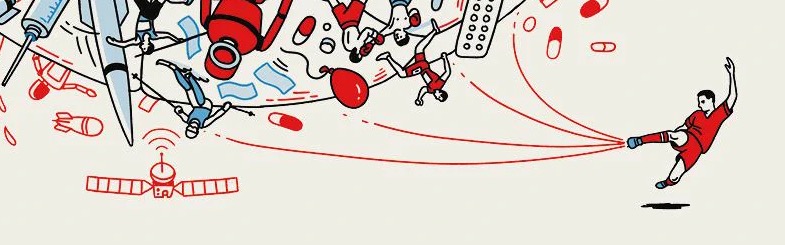
Interpretation. Lines converge on the footballer’s boot and visually suggest the movement of a kicked ball. They also help tie the crowded composition together. Treating them as puppet strings is a possible viewer metaphor, not a confirmed statement that one person controls every event. Nothing visible in the original cover labels the curves with months or dates.
7. The Trump caricature: political leadership as a disruptive force
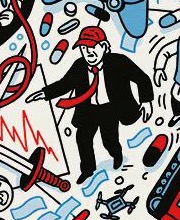
Interpretation supported by the issue’s subject matter. The red-capped, red-tied figure near the center-right appears to depict Donald Trump. He sits among economic, military and technological imagery. Our reading is that the artist is placing political decisions within a larger system of global consequences. A caricature’s position is not evidence that the individual planned every surrounding event. It does not establish a forecast of death, removal or a particular policy announcement.
8. The other leaders: competition between major powers
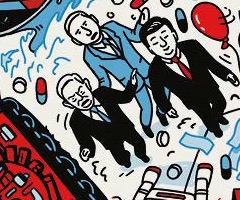
Interpretation. The cluster at the lower-left of the cake appears to include Vladimir Putin and Xi Jinping alongside another suited figure. Their proximity suggests negotiation, rivalry and shifting relationships between states. Exact identification of every small caricature should remain tentative without captions. Nor does putting leaders next to one another prove a secret alliance: editorial drawings routinely bring rivals into the same scene to show an issue’s competing actors.
9. The container ship: supply chains and the price of disruption
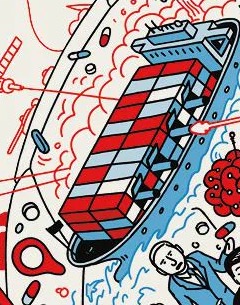
Documented context plus interpretation. The large vessel on the left carries stacked containers, a recognizable shorthand for international trade. UN Trade and Development’s 2025 maritime report, published before the cover, described volatile freight rates and disruption associated with geopolitical tensions. That gives the image an ordinary economic context: rerouting cargo can raise costs and delay goods. The ship does not name a future wreck, canal closure or specific maritime attack.
10. The ancient-looking ship: an overlooked cultural connection
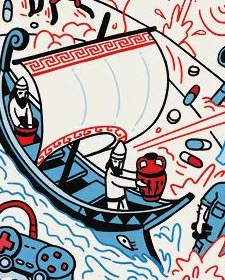
Documented cultural context; the exact visual link is unconfirmed. The upper-right vessel has an old-fashioned sail and classical-looking decoration. The Economist promoted an essay about Homer’s Odyssey and navigating 2026. Christopher Nolan’s film also had a publicly announced July 17, 2026 release. This makes a cultural reference more plausible than confidently calling the vessel a “Viking invasion.” We found no artist’s caption proving the connection or explaining the object carried aboard.
11. The crossed swords: conflict, with room for a classical reference
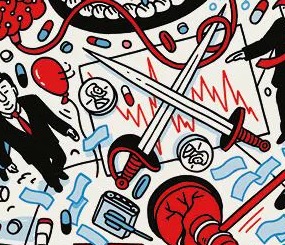
Interpretation. Crossed weapons are a familiar symbol of confrontation. Their placement can reinforce the contrast between military conflict and the ancient vessel nearby. A connection with classical adventure is also possible. There is no verified basis here for turning the swords into a named religious war or secret society emblem. A shape that can be made to resemble another symbol after mirroring or rotating it is not, by itself, evidence of intent.
12. The tanks: conventional warfare remains part of the picture
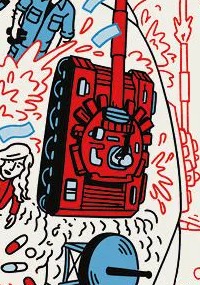
Interpretation. Tanks on opposing sides make military force difficult to overlook. They can suggest land warfare, rearmament and pressure on defense budgets. Their repetition also visually surrounds the civilian subjects with military risk. A small illustrated tank does not reliably identify a country or weapons model, and two tanks do not mean that exactly two wars were forecast.
13. The missiles and projectiles: escalation and deterrence
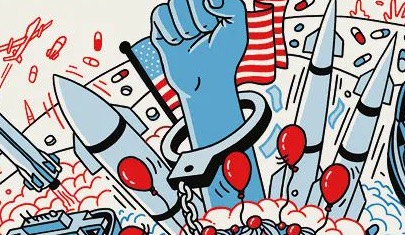
Interpretation. Pointed projectiles introduce the possibility of long-range attacks and the threat that military competition can escalate. The important distinction is between depicting a risk and specifying an event. This cover does not label a launch location, target, payload or date. A missile drawing cannot establish that a nuclear attack was predicted; identifying a weapon as nuclear requires additional evidence.
14. The small drones: remote technology enters the conflict
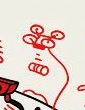
Interpretation. The repeated small rotor-like objects resemble drones. Their scale contrasts with the tanks and larger projectiles, suggesting that different kinds of military technology coexist. They can also evoke remote observation and surveillance. We did not find a caption identifying a manufacturer, an operation or whether every small airborne object is military rather than civilian.
15. The satellites: infrastructure becomes strategically important
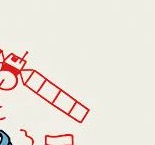
Documented discussion plus interpretation. Space competition is the opening topic in The Economist’s official 2026 video. The panel-like shapes around the circle are consistent with satellites. Our interpretation is that the illustration extends competition beyond borders on Earth. The visual alone cannot predict an internet blackout, the failure of GPS, or the destruction of a named satellite network.
16. The capsule and rocket-like forms: space is also exploration
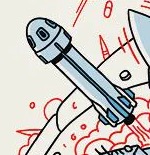
Contextual interpretation. A spacecraft-shaped object with a window should not automatically be counted as another missile. Space imagery can include human exploration as well as security. NASA had publicly identified the Artemis II crew, so lunar exploration was a legitimate subject for forward-looking journalism. We cannot establish from this drawing which particular vehicle or mission the illustrator intended.
17. The controller: gaming, interaction and who holds control
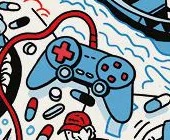
Interpretation. A gamepad is a recognizable entertainment object. It can refer directly to gaming, while its buttons and cord also invite a broader metaphor about control and increasingly mediated lives. An indexed copy of the edition’s contents includes coverage of the gaming industry. The drawing does not establish that real wars are scripted like a game or that a named game’s release date is guaranteed.
18. The humanoid robot: automation’s promises and limits
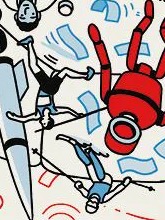
Documented context plus interpretation. The robot-like figure near the lower edge connects naturally with machines performing human tasks. In August 2025, the International Federation of Robotics published a report distinguishing humanoid ambitions from practical reality. This was an established technology debate before the cover appeared. The figure is not evidence that robots will replace every worker, or that it secretly represents a particular company.
19. The red glove-like object: competition and human performance
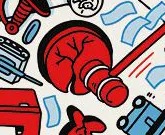
Unconfirmed detail; cautious interpretation. The close-up shows a red, padded-looking object with a cuff-like base. A boxing glove is a plausible visual reading, connecting it with competition, sport and physical performance. The publisher’s discussion of sport and human enhancement supplies relevant context, but we have not established an official caption identifying this particular object. It should not be presented as a confirmed brain, implant or prediction of a specific event.
20. The syringes: medicine and human enhancement
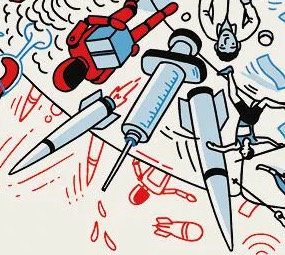
Documented subject matter; individual syringes are not labeled. The publisher explicitly highlighted new weight loss medicines, including GLP-1 treatments, while its official video discusses the Enhanced Games. These offer concrete contexts for injection imagery. A syringe is a method of delivering a substance, not a diagnosis: it cannot, on its own, distinguish vaccination, treatment, doping or another medical use. Its presence does not prove a planned pandemic.
21. The pills and blister pack: medicine beyond injections
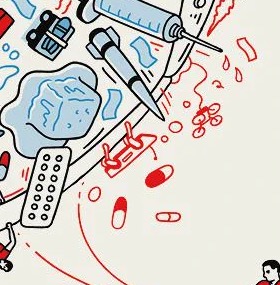
Interpretation with documented context. Tablets, capsules and a blister pack broaden the medical imagery. The launch announcement specifically discussed oral versions of weight loss drugs. Our reading is that the artwork can encompass convenience, access, commercialization and enhancement, rather than one disease. Counting the pills does not produce a verified date, and their colors do not identify a specific medicine.
22. The brain-like cluster and cord: intelligence, interaction and influence
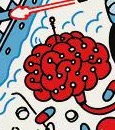
Visual interpretation; exact meaning unconfirmed. Enlarged, the red folded cluster beside the cake looks more like a stylized brain with a trailing cord than an identifiable microbe. Its proximity to the controller invites a reading about intelligence, gaming, interfaces and the relationship between people and technology. Those are plausible associations rather than an artist-confirmed explanation. The image does not establish a particular brain implant, mind-control program, named pathogen or predicted outbreak.
23. The disrupted dollar sign and scattered paper: financial strain
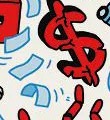
Interpretation supported by independent economic context. The red dollar symbol appears bent or disrupted; paper-like forms float through the composition. They can suggest money, debt, instability or uncertainty about economic power. Before publication, the IMF was already warning about stretched valuations and possible market corrections. That context does not confirm an exact meaning for the dollar drawing, and a damaged symbol is not proof that the currency will disappear.
24. The hand, paper and box: elections and political participation
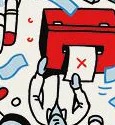
Interpretation. Near the lower-left of center, a hand and an X-marked paper appear with a box-like object. A ballot is a plausible reading, linking political participation with the larger struggle over authority. Without a label, it would be unsafe to assign this small scene to a particular country’s election or claim that it proves fraud, cancellation or a preselected winner.
25. Smaller objects: what remains unresolved
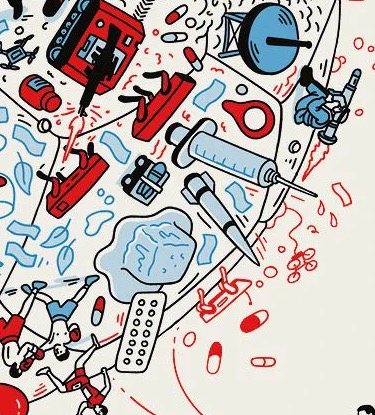
Not every recognizable outline has an established explanation. These details deserve an honest boundary rather than an invented answer:
| Detail | Possible reading and limit |
|---|---|
| Red machine or printer-like objects | Some viewers read financial or printing equipment; others describe a seismograph. We could not confirm the object or intended reference. It supplies no verified earthquake forecast. |
| Blue circular, dish-like object on the right | It can suggest communications or monitoring, but no caption establishes its identity. Calling it a “Doomsday Clock” would require evidence the image does not provide. |
| Small bottle and vessel-like shapes | Medicine, drinking or classical imagery are possible associations depending on the object. We found no verified key identifying their exact referents. |
| Flame-like marks, faces and angular blue patches | They help create an atmosphere of tension and motion. Individual identification as an island, named disaster, victim or historical person remains unconfirmed. |
| Red, blue and black palette | The limited colors connect otherwise different objects and create contrast. No verified legend assigns all red objects to one country and all blue objects to another. |
The overall reading: our interpretation is a world in which celebration, conflict, money, medicine, technology and culture collide. Some references are clear; others are intentionally compressed or ambiguous. There is no verified basis for promising a definitive hidden meaning for every mark.
Some apparent “predictions” were already known
America’s anniversary: The Declaration of Independence was adopted on July 4, 1776. The National Archives’ anniversary information identifies July 4, 2026 as the 250-year milestone. Referencing it required no advance access to an unknown event.
The World Cup: The United States, Canada and Mexico received hosting rights on June 13, 2018, according to U.S. Soccer’s contemporary announcement. The tournament was on the calendar years before the cover appeared.
Economic uncertainty: The IMF’s October 2025 World Economic Outlook had already projected global growth slowing to 3.1 percent in 2026. That figure was a forecast, not a final result. It demonstrates that economic concerns were already part of public debate.
Watch: The Economist’s own 2026 outlook
The Economist published Four stories to watch out for in 2026 on December 28, 2025. Its stated subjects include space competition, political pressure on central banks, the Enhanced Games and America’s anniversary. Watch it as a historical forecast made before 2026, rather than as a current news update.
Video: The Economist, via its official YouTube channel. Watch directly on YouTube if the embedded player is unavailable. This is third-party reporting and analysis.
What TikTok, Instagram and YouTube add to the discussion
YouTube: start with the publisher. The official Economist video embedded above has chapters on space competition at 0:21, central banks at 3:14, enhanced sports at 5:56 and America’s birthday at 8:49. Those published subjects give readers context. The video is not a complete, item-by-item legend for the cover.
Instagram: the artist’s credit is useful evidence. An indexed archive of Andrew Rae’s Instagram post, dated November 14, 2025, credits his work on the cover with art director Elizabeth Delphin. That identifies an illustrator and an art-production process. The accessible caption does not explain every object or claim supernatural foreknowledge. We could retrieve indexed text, not independently review the full Instagram post and all comments.
TikTok: a specific example of interpretation becoming a timetable. A July 31, 2026 report by Colombia.com describes creator Alex Saldierna assigning part of the cover to August and interpreting syringes and a machine-like object as warnings about health and earthquakes. This establishes that those claims were circulating; it does not establish that the predictions are correct. Direct TikTok playback was unavailable during our research, so this account is attributed to the outlet’s reporting.
Why the month-by-month reading needs caution. The original cover reproduced here contains no month labels or numbered monthly sectors. We found no publisher-issued key assigning a syringe, missile or machine to August or any other month. A creator’s overlay can make a circle resemble a calendar without demonstrating that the artist designed it as one.
Check that the image itself is genuine. Reuters reported on November 6, 2026 that a separate circulating 2027 cover was fake and quoted a publisher spokesperson giving November 26 as that edition’s publication date. That finding concerns the specific 2027 image, not the authentic 2026 cover. Never assume every picture carrying the magazine’s logo is an original publication.
Research limits: this update combines the cover itself, publisher material, accessible YouTube metadata, indexed Instagram text, and attributed reporting about TikTok. It does not claim that every social video was watched or that creators’ interpretations are verified facts. No complete official symbol key was located.
How to check a claim that “they predicted it”
Start with the original article and publication date. Ask whether it named a specific outcome, place and timeframe before the event happened. Then consider how many different events could fit the same symbol.
A missile drawing can resemble many conflicts. A chart can be connected to countless market movements. Selecting a resemblance after an event is weaker evidence than a clear written prediction made beforehand. A fair assessment must also examine forecasts that did not occur.
What readers can take away
The cover is a guide to the publication’s editorial agenda. It does not, by itself, demonstrate secret knowledge or control over world events. Readers can question the magazine’s assumptions without treating speculation as established fact.
The Economist describes its outlook as supporting free trade and classical liberal values. Recognizing that perspective is part of evaluating its analysis critically.
For readers following world news from Cleveland, the practical question is whether a claim can be traced to a dated source, tested against evidence and explained without adding details the source never supplied.
Cover image: The Economist, supplied by the reader and shown for identification and commentary. Original cover and artwork belong to their respective rights holders. Publisher’s official cover announcement. Cleveland Boricua is not affiliated with The Economist.
Featured thumbnail: AI-generated promotional composite featuring Khristian Santana. Its dramatic background is illustrative and does not depict an actual event. The full original cover remains reproduced inside the article for commentary.